


Optical vs Sonic Belt Tension Measurement: Key Differences and Applications
Your choice between an optical vs sonic belt tension meter comes down to two factors: belt access and the operating environment. Optical tension checkers, such as the Sanker SK-500, need line-of-sight but ignore ambient noise. Sonic tension checkers work well in tight spaces yet suffer from background sound. This tension measurement comparison helps you pick the right method.
Key Takeaways
- Choose an optical meter for tight, noisy, or dusty spaces. It uses light, so it ignores sound and magnetic fields.
- Pick a sonic meter for open, quiet areas. It works well when you can get close to the belt and keep background noise low.
- Both methods measure belt vibration to find tension. Your choice depends on your workspace and noise level.
Optical vs Sonic Belt Tension Meter: Core Principles
Both measurement approaches share a fundamental physics principle: they analyze belt vibration to determine tension. The distinction lies entirely in how each sensor captures that vibration. Understanding this core difference clarifies why one method outperforms the other in specific environments.
How Optical Sensors Detect Vibration
Optical sensors use a focused light source to detect oscillation without physical contact. The Sanker SK-500 employs an integrated red LED that tracks the natural frequency of a vibrating belt strand. The process follows a straightforward sequence: the technician taps the stationary belt to induce vibration, the LED optically senses the resulting oscillation, and the meter converts that frequency into a tension reading using belt mass and span length parameters.
This optical approach delivers exceptional immunity to ambient noise and magnetic fields. Factory floors generate substantial acoustic interference from compressors, conveyors, and pneumatic tools. Sonic-based instruments struggle in these conditions, but optical detection remains unaffected. The light beam ignores sound waves completely, producing consistent readings regardless of surrounding noise levels. This characteristic makes the optical method particularly valuable for dynamic measurement in production environments where acoustic disturbances are constant.
The optical sensor also offers superior repeatability. Each measurement relies on the same light-based detection mechanism, eliminating variability caused by microphone positioning or acoustic reflections. Technicians obtain identical readings across multiple trials, which proves essential when setting precise tension specifications.
How Sonic Sensors Capture Frequency
Sonic sensors operate on the principle of transverse string vibration, similar to plucking a guitar string. The technician holds a microphone near the belt, lightly strums or taps the belt surface, and the sensor captures the resulting sound waves. The meter analyzes the harmonic frequency and displays the corresponding tension value.
The measurement procedure requires careful technique. The operator must position the acoustic probe close enough to detect the vibration accurately while avoiding over-plucking that forces excessive belt movement. Three separate readings are typically taken, and the average frequency is displayed for comparison against published specifications.
Background noise presents the primary limitation for sonic methods. A passing forklift, nearby grinding operation, or even loud conversation can corrupt the frequency reading. The microphone cannot distinguish between belt vibration and ambient sound waves, leading to inaccurate tension calculations. This vulnerability restricts sonic meters to quieter environments where acoustic interference remains minimal.
The conversion from frequency to tension follows the same mathematical relationship for both methods. The fundamental equation is T = 4 × L² × m × f², where T represents belt tension in newtons, L is the free span length in meters, m is the belt mass per unit length in kg/m, and f is the measured frequency in Hz. For example, a belt with a 0.587 m span length and 0.158 kg/m mass (5V section) produces a target frequency of approximately 61 Hz for 800 N tension. If the measured frequency drops to 50 Hz, the actual tension calculates to 544.6 N, indicating significant tension loss during operation.
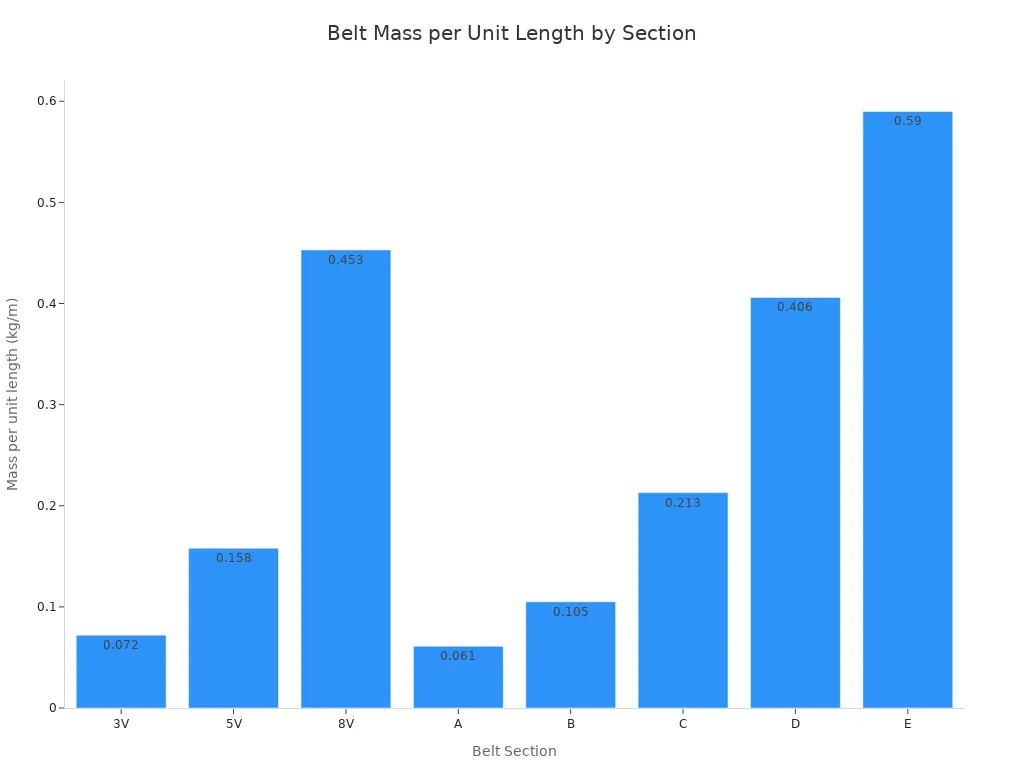
The chart above displays mass per unit length values for common V-belt sections. These parameters directly influence frequency calculations, making accurate belt data essential for reliable tension measurement.
How to Measure Belt Tension Using Frequency
Both optical and sonic belt tension meters share the same underlying calculation principle. They convert a measured vibration frequency into a tension value using two critical inputs: belt mass and free span length. The sensing technology differs, but the mathematics remains identical.
Measuring Tension Using Frequency: Optical Method
The Sanker SK-500 optical belt tension meter simplifies the conversion process through its integrated optical sensor. The technician taps a non-moving belt to induce oscillation, and the red LED light source captures the natural frequency of the strand vibration. The meter then displays the reading on an LCD screen in either frequency (Hz) or calculated strand force (Newtons or pound-force).
To obtain accurate tension values, the operator must input specific parameters before measurement:
- Set the belt mass (M) using the MASS button — example value: 000.9 g/m.
- Set the belt width (W) using the WIDTH button — example value: 010.0 mm/R.
- Set the span length (S) using the SPAN button — example value: 0100 mm.
The SK-500 accepts free strand length up to 9.99 meters and belt mass up to 9.999 kg/m. Its frequency measurement range spans 10 to 800 Hz, covering most industrial and automotive belt applications. If these specifications are not entered, conversion to a tension value in newtons cannot be performed and the device reports an error.
Measuring Tension Using Frequency: Sonic Method
Sonic belt frequency meters apply the same frequency-to-tension relationship but capture vibration through acoustic detection. The operator positions the microphone close to the belt surface without making contact, then plucks the belt to generate sound waves. The sensor analyzes the harmonic frequency and applies the identical mass and span parameters.
The critical distinction lies in sensor proximity. Sonic meters require the microphone to remain within a specific distance from the belt to capture the vibration accurately. Commercial sonic meters offer comparable frequency ranges — typically 10 to 800 Hz, with some models extending to 5000 Hz. However, ambient noise can corrupt readings, demanding quieter environments for reliable measurement.
Load the belt's span and mass data into the meter so it knows what it is calculating. The mass information can be provided by the belt manufacturer. Banded belts can be treated as a single unit with the belt mass calculated as a multiple of a single belt value.
Both methods deliver repeatability and accuracy when properly configured, but the optical approach offers greater immunity to environmental interference.
Access and Environment: Choosing the Right Method
The physical layout of your machinery and the acoustic character of your facility determine which sensing technology delivers reliable readings. An optical vs sonic belt tension meter comparison hinges on these two environmental factors more than any other consideration. The optical method requires a clear line of sight to the belt surface. The sonic method requires a quiet acoustic path. Each approach excels under different conditions.
Optical's Advantage in Compact and Noisy Environments
Optical belt tension meters thrive where space is constrained and noise levels run high. Modern electric vehicle engine compartments exemplify this environment perfectly. Dense component packaging leaves minimal clearance around serpentine belts, yet the integrated red LED of the SK-500 needs only a direct view of the vibrating strand. The technician taps the belt, aims the probe, and obtains a frequency reading without physical contact.
Acoustic interference poses no threat to optical detection. Factory floors generate continuous sound from pneumatic tools, cooling fans, and material handling equipment. A sonic sensor would struggle to isolate the belt's vibration from this cacophony. The optical sensor ignores sound waves entirely, capturing only the light reflection from the oscillating belt surface. This immunity extends to magnetic fields as well, which commonly emanate from electric motors and solenoids in automated production lines.
Dust and airborne particulates present another challenge that optical measurement handles gracefully. The light source and detector operate through a focused beam that tolerates moderate contamination. Vibration from adjacent machinery does not affect the measurement either, since the optical sensor locks onto the belt's natural frequency rather than external motion. Temperature fluctuations across typical industrial ranges do not degrade the LED's performance or the sensor's accuracy.
The SK-500's cabled probe option further enhances its suitability for confined spaces. Technicians can position the sensor head in tight gaps while holding the main unit at a comfortable viewing angle. This flexibility proves invaluable when measuring belts behind guards, beneath chassis components, or inside equipment enclosures.
Sonic's Flexibility in Open and Quiet Settings
Sonic belt tension checkers perform best in environments where sound waves travel unimpeded and background noise remains minimal. Large industrial facilities with high ceilings and generous equipment spacing provide ideal conditions. Conveyor systems in warehouses, agricultural machinery in open barns, and stationary industrial drives all offer the acoustic clarity sonic sensors require.
The measurement technique demands proximity without contact. The operator positions the microphone close to the belt surface, plucks the belt to induce vibration, and captures the resulting sound waves. This process works reliably when the surrounding area stays quiet enough for the sensor to distinguish the belt's frequency from ambient noise. A passing forklift, nearby grinding operation, or even loud conversation can corrupt the reading.
Open settings also allow technicians to position themselves comfortably for repeated measurements. The sonic method typically requires three separate readings to establish an average frequency. Generous workspace simplifies this procedure and reduces operator fatigue. The absence of acoustic obstacles ensures consistent sound wave capture across multiple trials.
However, sonic measurement struggles in dusty environments. Airborne particles can attenuate sound waves and reduce signal strength at the microphone. High ambient vibration from nearby machinery can also induce sympathetic vibrations in the belt, producing frequency readings that reflect external influences rather than true belt tension. Temperature extremes affect both methods minimally, but sonic sensors may experience slight sensitivity variations in very hot or cold conditions.
The practical rule remains straightforward. Choose an optical belt tension meter for confined, noisy, or dusty areas where line-of-sight access exists. Select a sonic meter for open, quiet, and spacious environments where acoustic clarity prevails. This tension measurement decision directly impacts the reliability of your maintenance data.
Application Suitability: Matching Tension Measurement to Belt Type
Ideal Applications for Optical Tension Meters
Optical tension checkers excel in automotive serpentine drives, compact machinery, and precision drive systems. These applications demand tight control over belt tension because small errors cause slippage or premature wear. The Sanker SK-500 meets this need with an accuracy of ±1 Hz and less than 5% deviation. Its measuring range of 10 to 800 Hz covers the natural frequency range typical of serpentine and compact precision drives.
| Requirement | Specification | Relevance |
|---|---|---|
| Accuracy | ±1 Hz (< 5% deviation) | Meets tight tolerance for serpentine belts and precision drives |
| Measuring Range | 10 – 800 Hz | Covers natural frequency range of automotive and compact drives |
| Sensing Principle | Optical (red LED) | Non-contact measurement for confined or delicate assemblies |
| Noise/Magnetic Immunity | Immune to ambient noise and magnetic fields | Reliable readings in engine bays and busy factories |
| Display Modes | Hz, N, lbf | Direct verification against manufacturer specifications |
A tension checker with optical sensing also suits delicate drive assemblies. The non-contact method avoids adding mass or deflection to the belt during measurement. Technicians obtain reliable accuracy and repeatability across repeated trials. The portable design of the SK-500 allows one-handed operation with a plug-in probe or a cabled probe for confined spaces.
Ideal Applications for Sonic Tension Meters
A sonic belt tension meter fits large industrial belts, conveyor systems, and agricultural equipment. These settings offer generous space and low ambient noise. The operator can position the microphone close to the belt surface without obstruction. A belt tension checker of this type works well when the belt span is long and the surrounding area stays quiet.
Sonic measurement struggles in dusty or cramped locations. Airborne particles attenuate sound waves and reduce signal strength. High ambient noise corrupts the frequency reading. A tension measurement instrument based on sound also requires careful microphone placement to capture the vibration accurately.
The rule of thumb is simple. Choose an optical belt tension meter for confined, noisy, or dusty environments. Select a sonic device for open, quiet, and spacious areas. This decision directly affects the reliability of your tension data.
Access and environment drive the choice between optical and sonic belt tension meter technologies. Compact, noisy, or dusty spaces demand an optical tension checker like the SK-500. Open, quiet areas permit sonic methods. Both approaches deliver non-contact measurement through frequency analysis, yet sensing technology determines repeatability. Evaluate your application's constraints. For reliable correct tension verification in challenging conditions, the SK-500 provides precision and immunity to interference.
FAQ
Can an optical tension checker measure belts in direct sunlight?
Direct sunlight can overwhelm the optical sensor. The Sanker SK-500 works best in shaded areas or indoor environments. Shield the belt from harsh light for accurate tension readings.
Does a sonic tension checker require a specific microphone distance?
Yes. The microphone must stay close to the belt surface without contact. Distance varies by model. Check your device manual for the recommended range to ensure reliable tension measurement.
Which method offers better repeatability for critical drives?
Optical tension checkers provide superior repeatability. The light-based sensor ignores ambient noise and magnetic fields. Sonic methods may produce variable readings in noisy environments, affecting tension data quality.