


How to Calculate Belt Tension from Vibration Frequency
Tension equals 4 times belt mass per unit length, times span length squared, times frequency squared (T = 4 × m × L² × f²). Measure the free span, confirm mass per unit length, capture the vibration frequency, then plug the values into the formula. By the end, you can run the belt tension frequency calculation yourself and judge whether the result is trustworthy.
Key Takeaways
-
Measure the free span, belt mass per unit length, and vibration frequency accurately.
-
Apply the formula T = 4 × m × L² × f² to calculate tension in newtons.
-
Compare your result with the manufacturer's specification and re-check after run-in.
Belt Tension and Frequency: The Basics

Why Tension Changes Frequency
A plucked belt behaves like a vibrating string. The belt frequency method relies on the standard formula for the vibration frequency of a string under tension. Higher tension produces a higher frequency reading. This relationship makes frequency a reliable indicator of static belt tension.
Three methods exist for checking timing belt tension: the sonic tension meter, the force-deflection test, and the elongation test. The frequency method applies only to rounded-tooth belts. Force-deflection tests are less accurate than a sonic meter, and elongation tests are not the most accurate method either. The force-deflection approach also has practical limits:
In many cases, the force-deflection method is the least accurate, since it's difficult to measure small deflections, and even for longer spans the process to measure deflection can be cumbersome.
A common field check uses a deflection rule of thumb of 1/64 inch per inch of span, applied at the midpoint of the longest span under a specified force. This is a starting point only. A sonic meter is more accurate and more repeatable.
Tools and Measurements You Need
The Sanker U-508 Sonic Belt Tension Meter is the recommended tool for this work. Its non-contact acoustic sensor delivers ±1% accuracy. The frequency range spans 10 to 5,000 Hz, and the tension range covers 0.01 to 99,900 N. The meter holds 48 pre-loaded belt constants and 500 onboard records, with selectable units of Hz, lb, N, and kg.
You need three measurements: the free span length, the belt mass per unit length (or a pre-loaded belt constant), and a clean frequency reading. Confirm each value before you calculate.
Step-by-Step Belt Tension Frequency Calculation
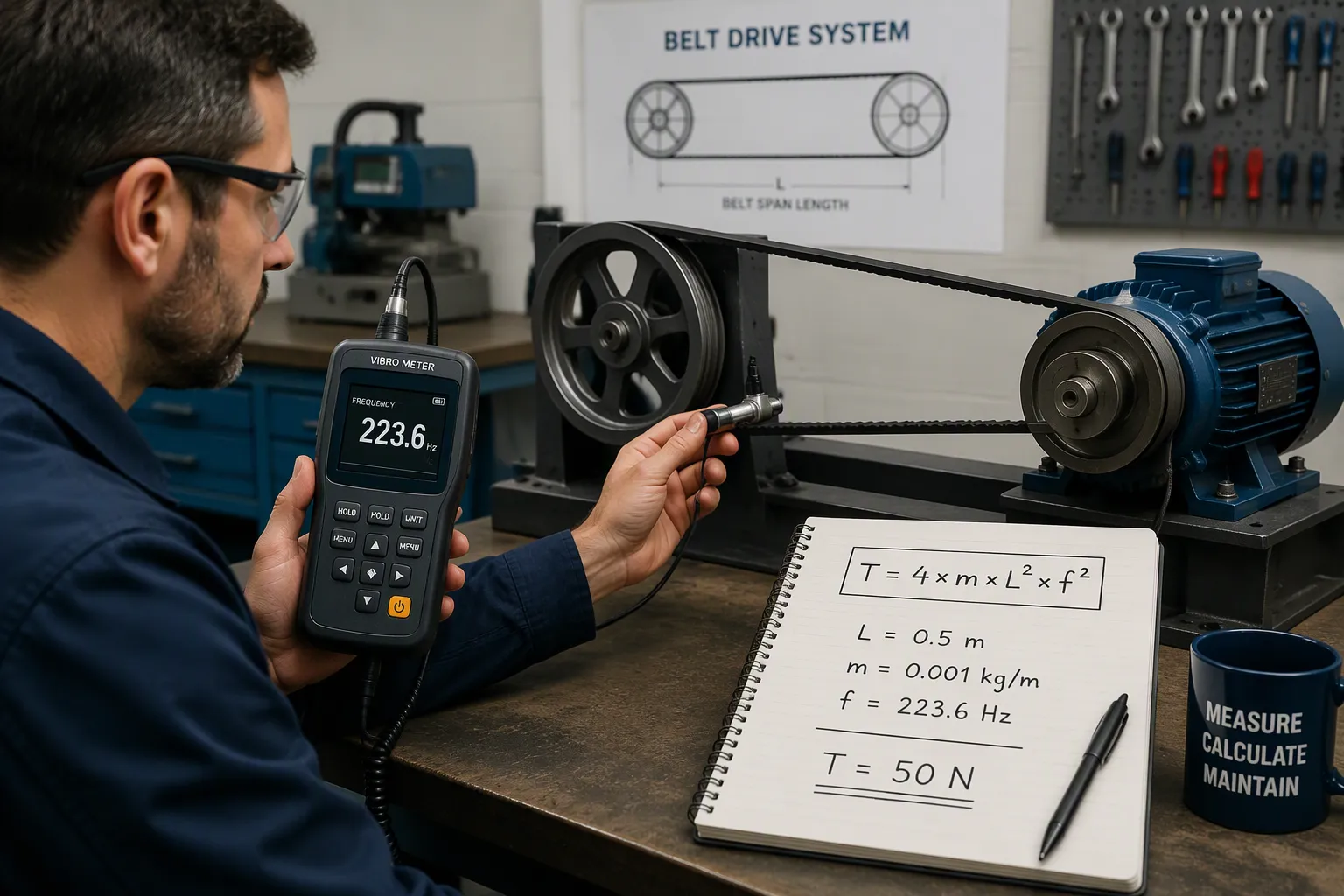
Running the Belt Tension Frequency Calculation
Work through the belt tension frequency calculation in a fixed order. Measure the free span length in meters. Confirm the belt mass per unit length in kilograms per meter, or select a pre-loaded belt constant. Capture the frequency in hertz with a clean reading. Apply T = 4 × m × L² × f², where T is tension in newtons, m is mass per unit length in kg/m, L is span in meters, and f is frequency in Hz. Convert the result to pounds if needed.
A worked example makes the arithmetic clear:
-
Use sample values: span L = 0.5 m, unit mass m = 0.001 kg/m, frequency f = 223.6 Hz.
-
Substitute: T = 4 × 0.001 × 0.5² × 223.6² N.
-
Evaluate the squares: 0.5² = 0.25 and 223.6² ≈ 50000.
-
Compute: T = 4 × 0.001 × 0.25 × 50000 = 50 N.
-
Convert to pounds: 50 N × 0.224809 = 11.24 lbf.
Compare the result against the belt manufacturer's specification. A reading inside the target range needs no adjustment. A reading outside the range calls for a tension change and a repeat measurement. Belt makers use variations of this equation, so follow their procedures and data.
Avoiding Common Errors
Inconsistent units ruin a belt tension frequency calculation. Convert span to meters and mass to kg/m before squaring. A span that is not free to vibrate also skews results. Background noise can corrupt the frequency reading, so isolate the belt or shield the sensor.
Watch for these additional pitfalls:
-
A span that is too short reads much higher than true tension because of belt stiffness; check the meter manual for the minimum span.
-
One reading is not enough; take three successive readings and record them.
-
Readings that differ by more than ten percent signal a technique problem, not a tension problem.
-
Belts under extremely low tension may not respond; increase tension until the meter does.
-
The frequency method applies only to rounded-tooth belts.
New belts should be tensioned 20–30% higher than the nominal value to compensate for initial stretch, and re-tensioned after 24–48 hours of operation.
For automotive work, set installation tension, run the belt for five minutes, then re-check tension with the meter.
Measure the free span, confirm mass per unit length, capture the vibration frequency, then apply T = 4 × m × L² × f². A clean reading and consistent units decide whether your belt tension frequency calculation holds up.
Check the result against the manufacturer's tension specification. Re-check after run-in before you adjust anything.
FAQ
Does the frequency method work on every belt type?
No. The vibration frequency method applies only to rounded-tooth belts. Other belt constructions call for a different tensioning check.
What if my calculated tension disagrees with the manufacturer's specification?
Trust the manufacturer's target range. Adjust tension, then repeat the measurement. Re-check after run-in before making further changes.
Do I need the belt's mass per unit length for every job?
Not always. The Sanker U-508 stores 48 pre-loaded belt constants. Select the matching constant and skip the manual mass entry.